Alice Siwoo's Story
지금은 테스트 중인 페이지 입니다.
Duke BME+ Electical and Computer Engineering


Duke BME students work in a design lab

Biomedical Engineering + Electrical and Computer Engineering Double Major


Become well prepared for a career in medical device design

The double major in biomedical engineering and electrical and computer engineering is an ideal option for students interested in the technical components behind biomedical engineering tools.

Students pursuing BME + ECE:

  • Complete interdisciplinary projects bridging BME, ECE and Duke Health
  • Collaborate closely with design experts and physicians as you learn how to develop practical biomedical devices and designs
  • Be well-prepared for a career in the medical equipment industry, which in the US is expected to grow to over $200 billion annually in the coming decade.

Students who pursue this curriculum will have the opportunity to participate in intensive design programs, where they can design medical devices and other hardware for physicians and researchers.

Jennifer VillaThe double major allowed me to explore two areas of study I was passionate about. As an ECE, I was able to dive deep into circuits and digital systems, and ultimately learn how computers today work. As a BME, I saw these same principles at work when learning about medical device design and electrical systems within our bodies themselves. Ultimately I was more competitive as a job applicant because I'd developed an ability to make connections across these areas and go deep in both of them.”

JENNIFER VILLA, ’13
PRODUCT MANAGER AT CRUISE (SELF-DRIVING CARS)

SAMPLE CURRICULUM


Students pursuing the BME + ECE double major must complete 37 credits from both programs:

First Year

Fall Semester

Spring Semester

  • CHEM 101DL Core Concepts in Chemistry or CHEM 110DL or CHEM 21 or Academic Writing 101
  • EGR 103L Computational Methods in Engineering
  • MATH 111L Laboratory Calculus I or MATH 21
  • EGR 101L Engineering Design and Communication
  • BIO 201L Gateway to Biology: Molecular Biology
  • MATH 112L Laboratory Calculus II or MATH 122L or MATH 22
  • PHYSICS 151L Intro Mechanics or PHYSICS 25
  • CHEM 101L or Academic Writing

Sophomore Year

Fall Semester

Spring Semester

  • BME 244L Quant Physiology with Biostat Appl
  • ECE 110L 
  • MATH 212 Multivariable Calculus1
  • PHYSICS 152L Intro Electr Magn Opt or PHYSICS 262
  • Social Science or Humanities Elective
  • EGR 201L Mechanics of Solids
  • CHEM 210DL Mod Apps Chem Principles or Chem 201DL Organic Chem
  • STA 130
  • MATH 216 Linear Algebra and Differential Eqn3
  • Social Science or Humanities Elective

Junior Year

Fall Semester

Spring Semester

  • BME 260L Modeling Cellular and Molecular Systems
  • ECE 110L
  • ECE 230L
  • MATH 353 Ordinary and Partial Diff Equations1
  • Social Science or Humanities Elective
  • BME 354L Intro to Medical Instrumentation
  • BME Area Core Class I3
  • ECE 250L
  • Social Science or Humanities Elective
  • ECE 270L

Senior Year

Fall Semester

Spring Semester

  • BME Design 4
  • BME Advanced Elective & ECE Elective
  • BME Advanced Elective
  • Life Science Elective
  • ECE 280L
  • BME Advanced Elective5
  • BME General Elective6
  • ECE Elective
  • BME 436L or BME 464L
  • Social Science or Humanities Elective


[Source : https://bme.duke.edu/undergrad/double-major/bme-ece]

이 게시물을

Biomedical Engineering: Overview, Education, Specializations, Universities, Careers and Jobs

Biomedical Engineering: Overview, Education, Specializations, Universities, Careers and Jobs

Last Updated on March 10, 2022


The Biomedical Engineering field has been getting a lot of interest in the past decade. However, students and parents are not too sure about the field of study and career prospects. People sometimes also get confused between Biomedical Science and Biomedical Engineering. This article will give you an exhaustive overview of Careers in Biomedical Engineering – subject areas, specializations, top study abroad destinations & universities, and job prospects after a degree in biomedical engineering.


Table of Contents:


Biomedical Engineering Careers


Biomedical Engineering Careers and Jobs


Biomedical Engineering, also known as Bioengineering, is an applied field of science and engineering at the intersection of engineering, biology, healthcare, and medicine. The field of biomedical engineering involves the application of principles of engineering (mechanical, electrical, electronics, computer science, and chemical engineering) and basic sciences (physics, mathematics, chemistry, and biology).


The objective of Biomedical Engineering


The aim of the field is to develop systems, equipment,  and devices in order to solve clinical problems – both diagnostics and therapeutics. Besides, the diagnosis and treatment of diseases, biomedical engineering also plays a big role in alleviating, rehabilitation, and compensating for disabilities and/or injuries.


This is a very hard-core technical field. So, biomedical engineering graduates need to possess an in-depth understanding of human biology (living systems) and engineering, along with strong technical and analytical skills.


What does a Biomedical Engineer do?


Some of the examples of applications of biomedical engineering are:


  • Prosthetics (e.g. Dentures, artificial limb replacements)
  • Surgical devices and systems (e.g. Laser surgery, robotics)
  • Monitoring systems (checking devices for blood glucose, heart rate etc.)
  • Therapeutic devices (insulin pumps, kidney dialysis, electrical nerve stimulation, sophisticated inhalers)
  • Artificial organs – valves, pacemakers
  • Imaging methods – ultrasound, X-ray, particle beams, MRI
  • Diagnostic systems like lab-on-a-chip
  • Physical therapy devices like exercise equipment and wearable tech gears.
  • Healthcare apps (for smartphones) for personalized medicine


what can you do with a degree in biomedical engineering


Where kind of Jobs are available for Biomedical Engineers?

Biomedical engineers usually get employed in the industry (healthcare, medical instrument, biomedical, pharmaceutical), hospitals, research organizations (including CROs), academia, and the government sector. Biomedical engineers often liaise and/or coordinate with medical doctors, clinicians, biomedical scientists, and healthcare professionals. Biomedical engineers use their expertise in engineering, life science, and medical fields.


Career Options for Biomedical Engineering Graduates


Besides technical roles (such as R&D, Process Development, Product development, QC/QA, and regulatory affairs), biomedical engineering graduates also work as marketing advisors and management consultants in the industry. It is also common for biomedical engineering graduates to have advanced training and qualifications in other fields depending on one’s skill-set and career interests. For instance, if you want to work in the core clinical field (direct patient care or clinical research), you can pursue a Medicine degree at the graduate level, after finishing an undergraduate degree in Biomedical Engineering. Sometimes, undergraduate medical students or MBBS graduates also switch towards biomedical engineering. Many biomedical engineers possess an M.D. Degree, thereby combining their knowledge of medicine and engineering.


Difference between Biomedical Engineering & Biomedical Science


The biomedical engineering field does overlap with the field of biomedical science(s). But, there is a significant difference. While biomedical engineers work around instrumentation and engineering; biomedical scientists put more focus on biological & life sciences, chemistry, and medicine.


Biomedical scientists usually work in the laboratory. They handle biological samples (blood, urine, cells, and tissues) and use a wide range of laboratory equipment ranging from test tubes, beakers, and pipettes to computers and hi-tech equipment.


Some of the common job roles and responsibilities of a biomedical scientist are:


– Testing and screening for lifestyle and infectious diseases
– Investigating and understanding the disease mechanisms, profile, and progression
– Conducting research on finding new, effective, and innovative ways to diagnose diseases as early as possible
– Working towards the discovery and development of novel treatments, which could be preventive (vaccines) and/or therapeutic (drugs and medicines)


Biomedical Science deals with human biology,  pathology,  biochemistry,  molecular and cell biology, genetics,  pharmacology,  immunology,  applied or clinical chemistry,  microbiology,  epidemiology, and biomedical engineering. Those who are interested in biomedical science, please refer to my post on Biomedical Science Jobs and Careers.


Job Prospects for Biomedical Engineering Graduates


In 2011,  Biomedical Engineering topped the list of Careers with the fastest-growing jobs. In 2015, biomedical engineering featured among the best 11 college majors for job prospects. The demand is on a rise, as biomedical engineering bagged the No. 2 position in the list of Best College Majors for Lucrative Career 2016-2017. In the US, as a fresh college graduate (or MS degree holder), you can expect to earn around USD $60, 000 per year. With five to ten years of experience, you can expect an annual paycheck of USD $96, 000. The figures can go for Ph.D. degree holders.


Read the story of Niren Murthy, who chose the field of Biomedical Engineering after getting to know the unlimited potential of the biomedical engineering field.
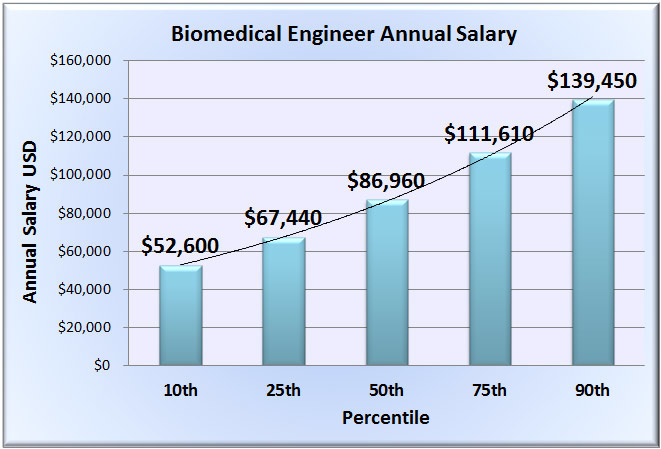


Information on Biomedical Engineering - Clarissa Struble


Biomedical Engineering Career Path


In order to study biomedical engineering at the undergraduate level, you need to have a PCM or PCB combination at the 10+2 level. It would be advantageous if you have got a PCMB combination. If you are not sure if your strengths, skills, and goals align with the biomedical engineering career path or not, try our Free Career Test or sign up for a Personalized Counselling Session.


Caution for those who want to pursue Bachelors in Biomedical Engineering in India


If you are really interested in the field of biomedical engineering and want to have an accomplished career, don’t go for bachelor’s in Biomedical Engineering in India straightaway. It’s better you do your Bachelors in Electronics, Mechanical, or Electrical Engineering from India, and then go for MS in biomedical engineering in abroad. If you are really keen to do a Bachelors in Biomedical Engineering, then abroad will be a better option. The main problem in India is that the infrastructure and labs are still not up to the standards. Getting a job after pursuing Bachelor in Biomedical Engineering in India is quite tough in India (and even many other Asian countries).


The USA would be one of the best destinations for undergraduate studies in biomedical engineering. Other top destinations for biomedical engineering would be Germany, Canada, the UK, Switzerland, Australia, Singapore, Netherlands, and Sweden.


Undergraduate Program in Biomedical Engineering in the US


In the US, for the first two years, you would study basic sciences and principles of engineering. The interdisciplinary nature and flexibility of the US education system will also allow you to switch engineering disciplines. With time familiar with the key concepts and terminology of human anatomy and physiology, as well as cell biology, thermodynamics, fluid mechanics, biomechanics, and computing and design for biomedical engineers.


Later, you will get to study and undergo training for the advanced level of core biomedical engineering. You study other modules on engineering and biomedical subjects such as engineering mathematics, mechanics, biomaterials, electronic engineering, engineering design, robotics, human anatomy, physiology, cardiovascular system, and neuroscience. Practicals will involve biomedical science, engineering design, product design, programming, computer simulations, and hospital (or clinic) visits.


Most of the foreign universities (especially the US, UK, and Canada) will also offer the opportunity of internships and industrial placements at the undergraduate level. Due to the interdisciplinary nature and complexity of the field, you do need to have hands-on and real-world experience for a considerable time period say 3 – 9 months; unlike a day-visit to a company or one month of industrial training.


Top 10 US universities for Biomedical Engineering at the Undergraduate Level


Johns Hopkins University
Georgia Institute of Technology
University of California – San Diego
Carnegie Mellon University
Columbia University
Duke University
MIT
The University of Texas at Austin
University of Virginia
Washington University – St. Louis


Top Universities for Biomedical Engineering in the World


Postgraduate Studies in Biomedical Engineering


At the postgraduate level (MS or Ph.D.), you can specialize in a further specialized area of biomedical engineering. Let’s have a look at those exciting fields.


Top 10 Specializations of Biomedical Engineering


Bioinstrumentation involves the application of electronics and instrumentation techniques to develop devices for the diagnosis and treatment of diseases.


Biomechanics It includes the study of motion, material deformation, fluid flow within the human body (and in devices), and transport of chemical constituents across biological systems.


Biomaterials describe both living tissue and materials used for implantation. Understanding the properties of the living material is vital in the design of implant materials. The biomaterials are designed to integrate with the biological systems (organs, tissues, and blood).


Systems Physiology is the field of biomedical engineering in which engineering strategies, techniques, and tools are used to gain a comprehensive and integrated understanding of the function of living organisms ranging from bacteria to humans. Later, the modeling comes into play for the analysis of experimental data and in formulating mathematical descriptions of physiological events.


Clinical Engineering is the application of technology for health care in hospitals. The clinical engineer is a member of the health care team along with physicians, nurses, and other hospital staff. Clinical engineers are responsible for developing and maintaining the computer database of medical instrumentation and equipment records and for the purchase and use of supplicated medical instruments.


Rehabilitation Engineering is a new and growing specialty area of biomedical engineering. Rehabilitation engineers expand capabilities and improve the quality of life for individuals with physical impairments.


Medical Imaging basically involves taking pictures inside the human body to diagnose diseases.


Tissue Engineering revolves around creating tissues and tissue materials to replace failing and compromised bodily functions.


Neural Engineering focuses on the interaction between the nervous system of the body and any artificial medical device. It is one of the coolest and most exciting stuff within the field of biomedical engineering.


Computational Modelling deals with simulations and investigating (including visualization) of what’s going on in our cells and organs. This is another rocking field of biomedical engineering.


Top Universities for Biomedical Engineering in the World for MS/PhD


  • Georgia Institute of Technology
  • Stanford University
  • MIT
  • Johns Hopkins University
  • UC Berkeley
  • Boston University
  • Northwestern University
  • UT Austin
  • Rice University
  • University of Michigan – Ann Arbor
  • University of Pennsylvania
  • Duke University
  • University of British Columbia
  • University of New South Wales
  • ETH Zurich
  • EPFL
  • Imperial College London
  • Harvard University
  • University of Cambridge
  • Rochester Institute of Technology
  • University of Sheffield
  • University of Twente
  • TU Munich
  • Hamburg University of Applied Sciences
  • University of Freiburg
  • RWTH Aachen University
  • Wageningen University
  • Utrecht University
  • University of Groningen
  • TU Delft (aka Delft University of Technology)
  • KTH Royal Institute of Technology
  • Chalmers University of Technology
  • Linkoping University
  • Karolinska Institute
  • University College Dublin
  • Trinity College Dublin
  • University of Birmingham
  • Ghent University
  • Free University of Brussels
  • Czech Technical University
  • University of Southampton
  • Newcastle University
  • University of Glasgow


You might also like to read about the Top 10 MS Specializations to Study Abroad


CEMACUBE


Have you heard about CEMACUBE? CEMACUBE (Common European MAster’s CoUrse in Biomedical Engineering) is an excellent program and is one of the best Master’s programs in the world for Biomedical Engineering. If you require professional assistance with applications and/or admission, please refer to our services.


Future of Biomedical Engineering


Healthcare is a necessity. With the increasing complexity of our lifestyle, environmental factors, and the increase of the aging population – there is a growing need for advanced medical technologies. Besides, the increasing overlap between medicine and technology, the field of biomedical engineering will be getting more popular in the coming future.


Last but not the least, we are now getting into the era of Digital Health and Personalized Medicine. Have you heard about Elon Musk’s plan about self-driving cars that can take the driver/owner to a nearby hospital in case of a heart attack or stroke? Read about Elon Musk’s Masterplan on Digital Health, and the news on Tesla’s Autopilot Car that took the Owner to the Hospital. Thus, Biomedical Engineering is all about the advancement of the quality of life and healthcare.


If you have got any further queries about higher studies, career roadmap, or jobs & careers in biomedical engineering, please feel free to post your query in the comment box below. Don’t forget to share the article, and let others know about this exciting field of biomedical engineering.


[Source : https://www.stoodnt.com/blog/biomedical-engineering-overview-education-specializations-universities-careers-and-jobs/]


이 게시물을

university Info.
  • nagamja
  • 2022.10.03 09:04:52
  • 조회 수: 16

이 게시물을

How to Raise a Pig for Its Organs
  • Alice
  • 2022.09.26 21:17:50
  • 조회 수: 20

[Source :  https://slate.com/technology/2022/08/xenotransplantation-pigs-heart-kidney-donor-virus.html]

SCIENCE

How to Raise a Pig for Its Organs

Xenotransplantation could be the future—if only the pigs could be kept virus-free.

20220927_174456.png


These pigs are too dirty. Photo by Kenneth Schipper Vera on Unsplash


Not too far in the future, everyone will know someone who has a pig organ inside their body. At least, that’s what xenotransplantation researchers hope.

Over the past year, surgeons have been busy creating pig-human hybrids. In New York and Birmingham, they transplanted pig kidneys into three brain-dead humans—proof-of-concept operations. In Baltimore, surgeons transplanted a pig heart into a living person with end-stage heart failure.

If these pig organ transplants became commonplace, they could save a lot of lives. There are over 100,000 Americans on the national transplant list, and seventeen people die every day waiting. Kidneys are highest in demand, followed by livers, hearts, and lungs. The dream is to end this shortage with pigs.

But these transplants aren’t as easy as plucking a pig from a farm and putting its organs into humans. It’s a highly technical process, rife with risks. Take the Baltimore example where the 57-year-old patient David Bennett got infected with the pig virus pCMV and passed away 60 days after his surgery, as reported in The New England Journal of Medicine. Bennett’s death epitomizes the continued danger and uncertainty over xenotransplantation since it’s a process all too easily felled by viruses. There are major hurdles to clear if animals are to become a reliable source of organs for people. Chief among them is how do you make sure the pig’s “donation” won’t be carrying something that infects the recipient?

Non-human primates, such as chimpanzees and baboons, were initially the animal of choice, but they fell out of favor in the ‘90s. Their biggest advantage—similarity to humans—elicited their downfall. Animal rights organizations protested the use of our “closest evolutionary cousins.” And the public was worried that a monkey virus could make it into humans. After all, HIV originated in chimpanzees.

Pigs, in turn, had a lot going for them. With centuries of agricultural experience under our belt, pigs were easier to breed, keep pathogen-free, and even genetically engineer.

That last part is crucial because, before these pigs are even born, they needed to be “humanized” so that their organs are compatible with our bodies. This is done using the gene-editing tool CRISPR. There’s the three-gene pig (as in, three genes have been added or deleted), the five-gene pig, the ten-gene pig, and the sixty-gene pig, with a Goldilocks-like debate over how many changes are just right. Everybody agrees that, at minimum, three pig genes need to be knocked out so that our bodies have a fighting chance of accepting the organ. Beyond that, you have two general theories: “size doesn’t matter” and “the bigger, the better.”

Researchers Joseph Tector and Eckhard Wolf are the minimalists. They believe the limitations of CRISPR call for modesty. For one, CRISPR is not entirely efficient, meaning that it alters only a percentage of earmarked DNA. And secondly, CRISPR causes all kinds of off-target mutations, inadvertently snipping up other bits of DNA. Going for as simple a pig as possible, both argued, is the best way to ensure a consistent product.

Biotechnology companies Revivicor and eGenesis, on the other hand, are the embellishers, hoping that with a more ambitious set of edits, they can eliminate the need for immunosuppression and get the best long-term survival. “Some of our colleagues and competitors are minimum editing,” eGenesis’ CEO Mike Curtis said, “because, well, they can’t do anything else.” After several years of testing and dozens of iterations, Revivicor and eGenesis have been able to ensure more-or-less consistent models.

Regardless of the CRISPR strategy, once the necessary genetic modifications are made, the pig embryos are transferred into a surrogate inside a designated pathogen-free (DPF) facility. The name of the game is to keep everything sterile. Imagine a concrete facility—it’s easy to wash down—with filtered air, UV-treated water, and no way for pigs to go outside. Basically the polar opposite of a pigsty.

For pigs, pregnancy naturally lasts exactly three months, three weeks, and three days. A few days before this 3-3-3 delivery date, surgeons will perform a caesarean section, because vaginal births leave piglets at risk of pCMV and other pathogens. The pigs will go straight from the womb into a bath of disinfectant. Then, they’ll be raised in isolation boxes, away from their mothers.

These pigs are fed a kind of baby formula by technicians dressed up in “spacesuits” (you couldn’t technically go to space in them, but they would comprehensively cover your body.) Regular screenings check for viruses; pigs that test positive for the bad ones—those that might infect humans—are killed. And after about six months when they’ve grown to adult human size, these pigs are ready to have their organs cut out and transplanted—if everything goes well, without any viruses enclosed.

But Bennett, the Baltimore patient who briefly lived with a pig heart, still got pCMV. His pig was screened four separate times before transplantation via nasal swab and PCR, testing negative for the virus every single time. What Bennett’s surgeon Bartley Griffith thinks may have happened is that the pig had a dormant pCMV infection that “hitched a ride” via the donor heart and reactivated in Bennett’s immunosuppressed body. Griffith’s team successfully treated the infection, but it was too late—the virus had likely already done too much damage to Bennett’s heart. “We won the battle, lost the war,” Griffith said.

However, losing this war signals trouble for the pig-organ dream. Every xenotransplantation expert I spoke to was surprised that Bennett was infected with a pig virus. For twenty years, it’s been known that you need to get rid of pCMV to make pig-heart transplants possible, and the protocol for raising pigs has the express purpose of ensuring a clean donor. So, Bennett’s infection by pCMV is not only baffling but also alarming, to say the least. When speaking to The New York Times, Griffith nonetheless predicted, “Knowing it was there, we’ll probably be able to avoid it in future.”

Still, the difficulty of ensuring a clean pig reveals how the road ahead may still be winding and uncertain. We don’t know what pig we should be using. We don’t know whether pig hearts can sustain humans long-term. We don’t know what we don’t know.

After all, if the patient got infected with pCMV of all things, despite the precautions, then, Curtis asked, “what else could possibly happen?”

이 게시물을

이 게시물을 삭제하시겠습니까?

How to Raise a Pig for Its Organs
SCIENCE

How to Raise a Pig for Its Organs

Xenotransplantation could be the future—if only the pigs could be kept virus-free.

Two pigs in a pen.

These pigs are too dirty. Photo by Kenneth Schipper Vera on Unsplash


Not too far in the future, everyone will know someone who has a pig organ inside their body. At least, that’s what xenotransplantation researchers hope.

Over the past year, surgeons have been busy creating pig-human hybrids. In New York and Birmingham, they transplanted pig kidneys into three brain-dead humans—proof-of-concept operations. In Baltimore, surgeons transplanted a pig heart into a living person with end-stage heart failure.

If these pig organ transplants became commonplace, they could save a lot of lives. There are over 100,000 Americans on the national transplant list, and seventeen people die every day waiting. Kidneys are highest in demand, followed by livers, hearts, and lungs. The dream is to end this shortage with pigs.

But these transplants aren’t as easy as plucking a pig from a farm and putting its organs into humans. It’s a highly technical process, rife with risks. Take the Baltimore example where the 57-year-old patient David Bennett got infected with the pig virus pCMV and passed away 60 days after his surgery, as reported in The New England Journal of Medicine. Bennett’s death epitomizes the continued danger and uncertainty over xenotransplantation since it’s a process all too easily felled by viruses. There are major hurdles to clear if animals are to become a reliable source of organs for people. Chief among them is how do you make sure the pig’s “donation” won’t be carrying something that infects the recipient?

Non-human primates, such as chimpanzees and baboons, were initially the animal of choice, but they fell out of favor in the ‘90s. Their biggest advantage—similarity to humans—elicited their downfall. Animal rights organizations protested the use of our “closest evolutionary cousins.” And the public was worried that a monkey virus could make it into humans. After all, HIV originated in chimpanzees.

Pigs, in turn, had a lot going for them. With centuries of agricultural experience under our belt, pigs were easier to breed, keep pathogen-free, and even genetically engineer.

That last part is crucial because, before these pigs are even born, they needed to be “humanized” so that their organs are compatible with our bodies. This is done using the gene-editing tool CRISPR. There’s the three-gene pig (as in, three genes have been added or deleted), the five-gene pig, the ten-gene pig, and the sixty-gene pig, with a Goldilocks-like debate over how many changes are just right. Everybody agrees that, at minimum, three pig genes need to be knocked out so that our bodies have a fighting chance of accepting the organ. Beyond that, you have two general theories: “size doesn’t matter” and “the bigger, the better.”

Researchers Joseph Tector and Eckhard Wolf are the minimalists. They believe the limitations of CRISPR call for modesty. For one, CRISPR is not entirely efficient, meaning that it alters only a percentage of earmarked DNA. And secondly, CRISPR causes all kinds of off-target mutations, inadvertently snipping up other bits of DNA. Going for as simple a pig as possible, both argued, is the best way to ensure a consistent product.

Biotechnology companies Revivicor and eGenesis, on the other hand, are the embellishers, hoping that with a more ambitious set of edits, they can eliminate the need for immunosuppression and get the best long-term survival. “Some of our colleagues and competitors are minimum editing,” eGenesis’ CEO Mike Curtis said, “because, well, they can’t do anything else.” After several years of testing and dozens of iterations, Revivicor and eGenesis have been able to ensure more-or-less consistent models.

Regardless of the CRISPR strategy, once the necessary genetic modifications are made, the pig embryos are transferred into a surrogate inside a designated pathogen-free (DPF) facility. The name of the game is to keep everything sterile. Imagine a concrete facility—it’s easy to wash down—with filtered air, UV-treated water, and no way for pigs to go outside. Basically the polar opposite of a pigsty.

For pigs, pregnancy naturally lasts exactly three months, three weeks, and three days. A few days before this 3-3-3 delivery date, surgeons will perform a caesarean section, because vaginal births leave piglets at risk of pCMV and other pathogens. The pigs will go straight from the womb into a bath of disinfectant. Then, they’ll be raised in isolation boxes, away from their mothers.

These pigs are fed a kind of baby formula by technicians dressed up in “spacesuits” (you couldn’t technically go to space in them, but they would comprehensively cover your body.) Regular screenings check for viruses; pigs that test positive for the bad ones—those that might infect humans—are killed. And after about six months when they’ve grown to adult human size, these pigs are ready to have their organs cut out and transplanted—if everything goes well, without any viruses enclosed.

But Bennett, the Baltimore patient who briefly lived with a pig heart, still got pCMV. His pig was screened four separate times before transplantation via nasal swab and PCR, testing negative for the virus every single time. What Bennett’s surgeon Bartley Griffith thinks may have happened is that the pig had a dormant pCMV infection that “hitched a ride” via the donor heart and reactivated in Bennett’s immunosuppressed body. Griffith’s team successfully treated the infection, but it was too late—the virus had likely already done too much damage to Bennett’s heart. “We won the battle, lost the war,” Griffith said.

However, losing this war signals trouble for the pig-organ dream. Every xenotransplantation expert I spoke to was surprised that Bennett was infected with a pig virus. For twenty years, it’s been known that you need to get rid of pCMV to make pig-heart transplants possible, and the protocol for raising pigs has the express purpose of ensuring a clean donor. So, Bennett’s infection by pCMV is not only baffling but also alarming, to say the least. When speaking to The New York Times, Griffith nonetheless predicted, “Knowing it was there, we’ll probably be able to avoid it in future.”

Still, the difficulty of ensuring a clean pig reveals how the road ahead may still be winding and uncertain. We don’t know what pig we should be using. We don’t know whether pig hearts can sustain humans long-term. We don’t know what we don’t know.

After all, if the patient got infected with pCMV of all things, despite the precautions, then, Curtis asked, “what else could possibly happen?”


이 게시물을